

Recently, many Amazon sellers have noticed a prominent notification appearing on the Account Health page in Seller Central:
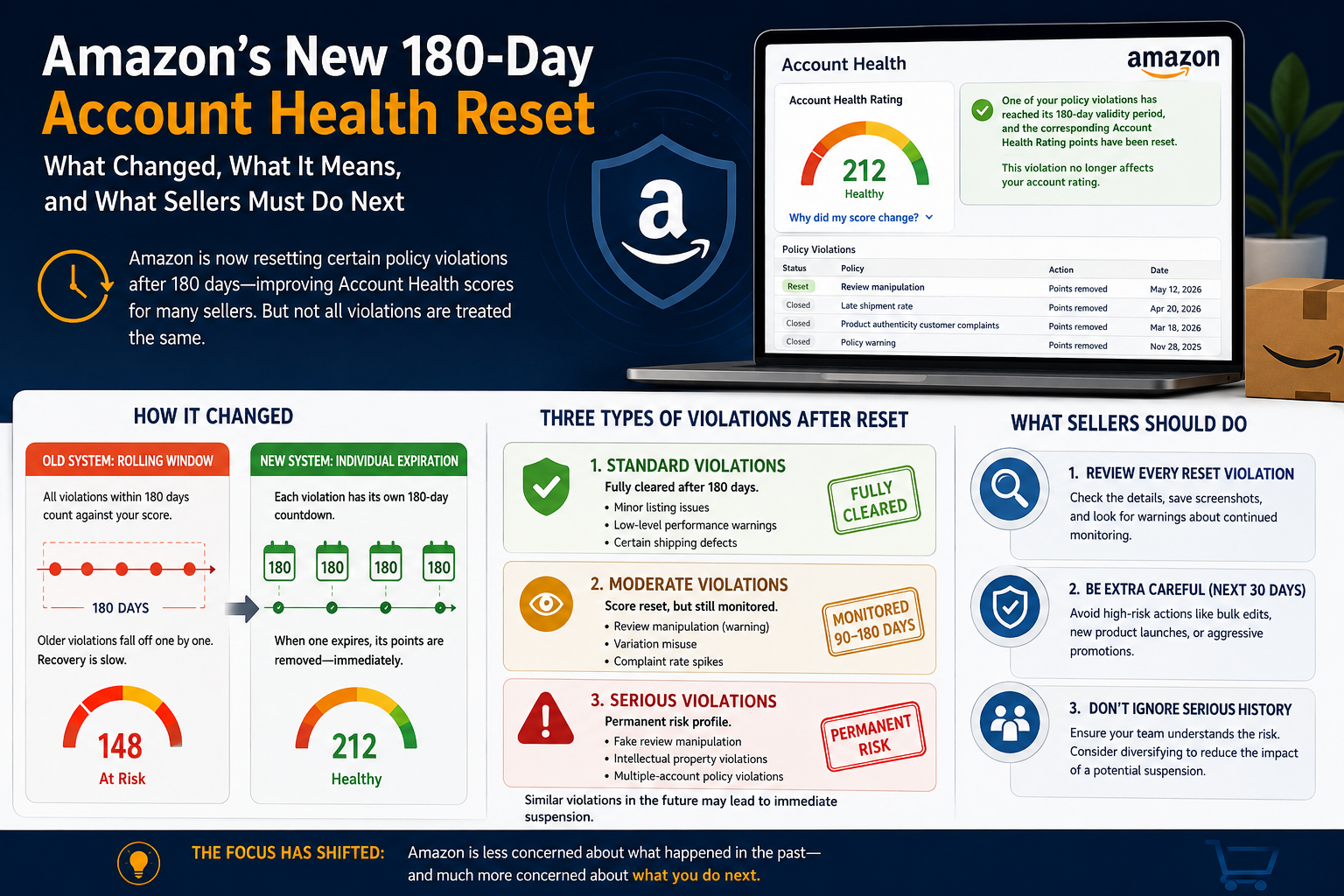
“One of your policy violations has reached its 180-day validity period, and the corresponding Account Health Rating (AHR) points have been reset.”
The notification also states:
“This violation no longer affects your account rating.”
For many sellers, this resulted in an overnight increase of 10, 20, or even 30+ Account Health Rating points. Accounts that had been dangerously close to the suspension threshold suddenly appeared much healthier.
However, not everyone had the same experience.
Some sellers received the reset notification along with a warning email stating:
“We will continue to monitor your account. Historical violation patterns may be considered during future reviews.”
Even more concerning, several sellers reported receiving a new “Account at Risk” warning immediately after an 18-month-old review manipulation warning had supposedly been “cleared.”
So, what is really happening?
This isn’t simply Amazon forgiving old violations. It’s a fundamental change to how the Account Health Rating (AHR) system works.
What Changed?
From a Rolling Window to Individual Expiration
Previously, Amazon used a 180-day rolling window.
Every policy violation remained active for 180 days, and all active violations collectively determined your Account Health Rating.
Imagine accumulating six violations within 180 days.
Even if the earliest violation was about to expire, the later violations continued stacking on top of it, making it difficult for your account to recover.
Your score only improved gradually as violations slowly aged out.
The New System
Amazon now manages each violation independently.
Once a specific violation reaches its own 180-day lifespan:
- Its penalty is immediately removed.
- Your Account Health Rating is recalculated.
- A Performance Reset notification is generated.
Think of each violation as having its own countdown timer.
When the timer reaches zero, that violation is removed regardless of the status of your other violations.
Which Violations Are Really Gone?
Based on seller reports, Amazon currently appears to treat expired violations in three different ways.
1. Standard Violations (Fully Cleared)
Examples include:
- Minor listing policy violations
- Minor authenticity issues
- Low-level performance warnings
- Certain shipping performance defects
After 180 days:
✅ Points are restored
✅ No additional warning
✅ Generally considered completely removed
2. Moderate Violations (Score Reset, History Retained)
Examples include:
- Review manipulation warnings
- First-time review abuse
- Variation misuse
- Temporary complaint-rate flags
Although the score resets, Amazon may continue monitoring your account.
If a similar violation occurs again within the next 90–180 days, the previous record may be reactivated and considered during enforcement.
Think of it as getting one second chance—not a clean slate.
3. Serious Violations (Permanent Risk Profile)
Examples include:
- Fake review manipulation
- Intellectual property violations
- Multiple-account policy violations
- Repeated restricted product listings
Even after the score resets, Amazon may permanently flag the account internally.
Future violations of the same type could trigger immediate suspension without another warning.
Why Is Amazon Doing This Now?
Several factors appear to be driving this update.
1. Regulatory Compliance
New regulations—including the EU Digital Services Act (DSA) and the U.S. INFORM Consumers Act—are pushing online marketplaces toward more transparent enforcement systems.
Keeping violations on an account indefinitely without a clear expiration process creates legal challenges.
The new reset mechanism helps Amazon meet these regulatory expectations.
2. Preparing for Prime Day 2026
With Prime Day 2026 approaching, Amazon wants a larger pool of healthy, active sellers eligible to participate.
Resetting historical violations allows more sellers to qualify for major promotional events.
3. Smarter—Not Softer—Enforcement
This update should not be interpreted as Amazon becoming more lenient.
Instead, Amazon appears to be shifting from:
Tracking historical violations
to
Closely monitoring recent behavior
Many sellers have reported that new policy violations are now being enforced much faster—often within 24–48 hours, compared with several days in the past.
What Sellers Should Do Next
1. Review Every Cleared Violation
Don’t just celebrate the higher score.
Open each expired violation individually and look for phrases such as:
- “We may continue monitoring your account.”
- “This violation type is not eligible…”
- “This decision is final.”
If you see these messages:
- Save screenshots.
- Document the violation.
- Implement procedures to prevent it from happening again.
2. Treat the Next 30 Days as a High-Risk Period
Your Account Health Rating may have improved, but Amazon is likely watching your account more closely during this period.
Avoid unnecessary risks such as:
- Merging or splitting variations
- Bulk listing edits
- Launching many new ASINs
- Aggressive promotional campaigns
A conservative approach now can protect your newly restored score.
3. Don’t Ignore Serious Historical Violations
If your account has ever received a major policy violation—even one that now appears “cleared”—assume Amazon still remembers it.
Make sure your entire team understands the risk.
If possible, gradually diversify your business by moving key products to healthy backup accounts to reduce the impact of a potential future suspension.